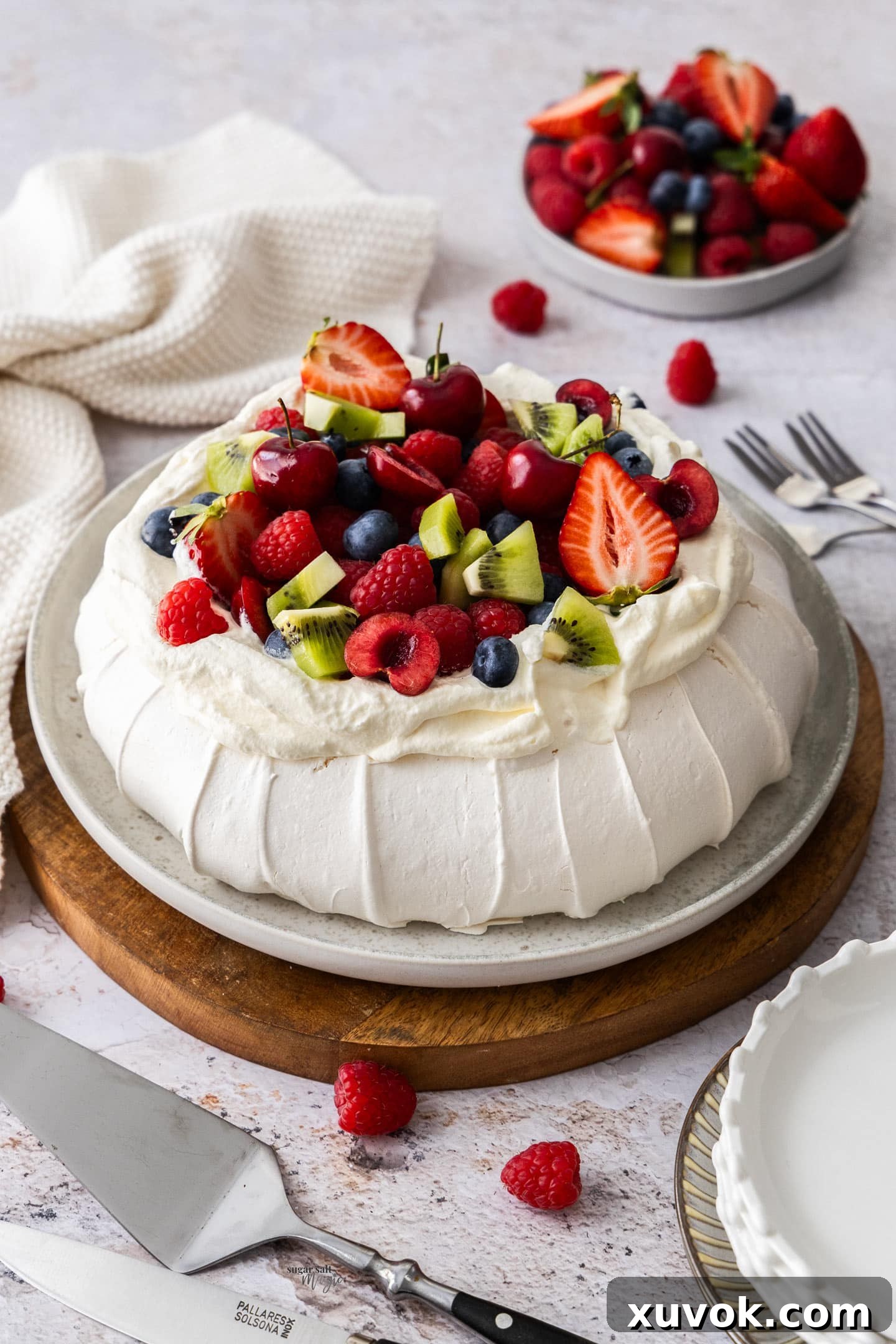
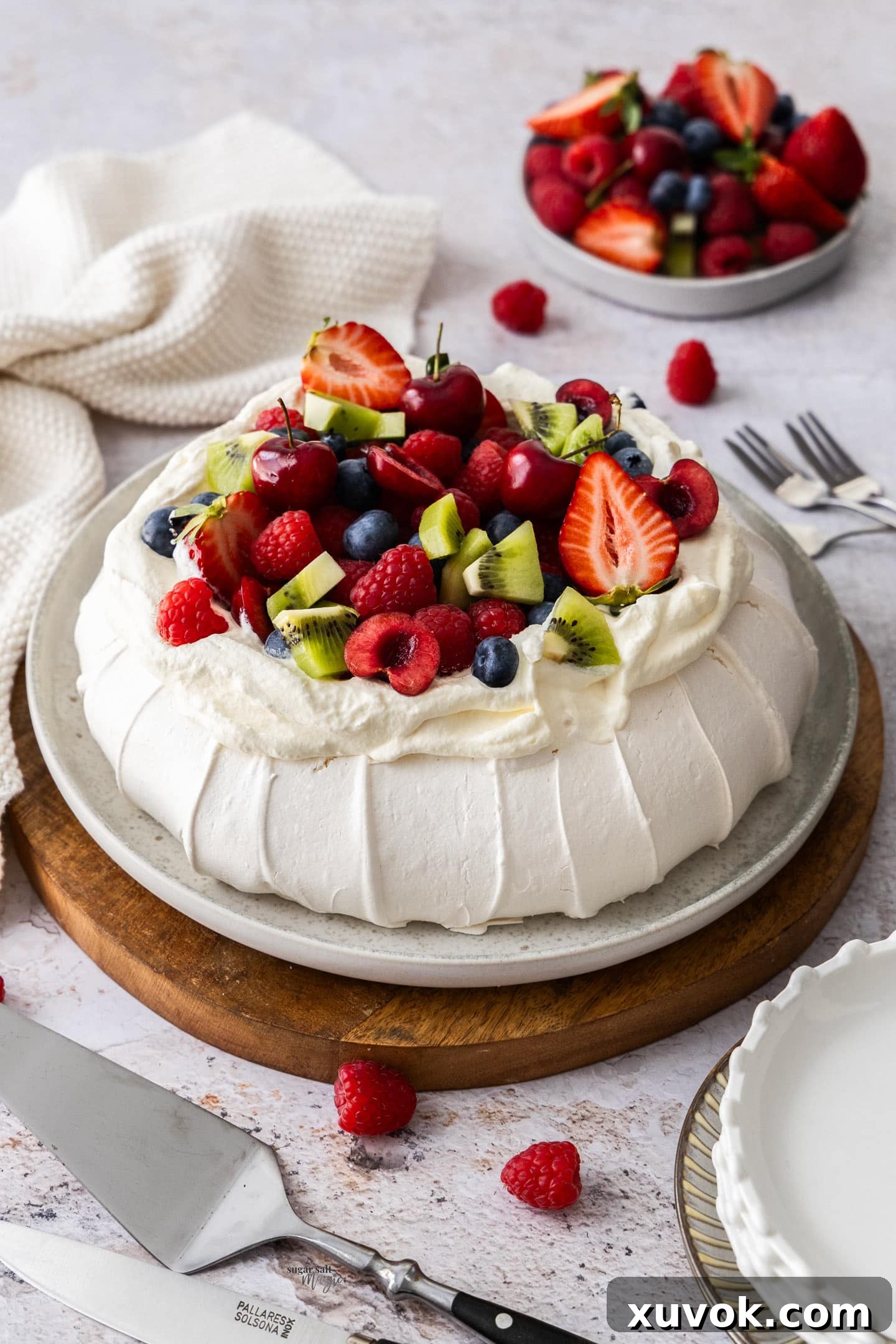
Among the pantheon of Australian culinary delights, the perfect pavlova stands out as a true icon. This exquisite dessert, a cherished memory from my own upbringing, arguably holds the top spot as my all-time favorite.
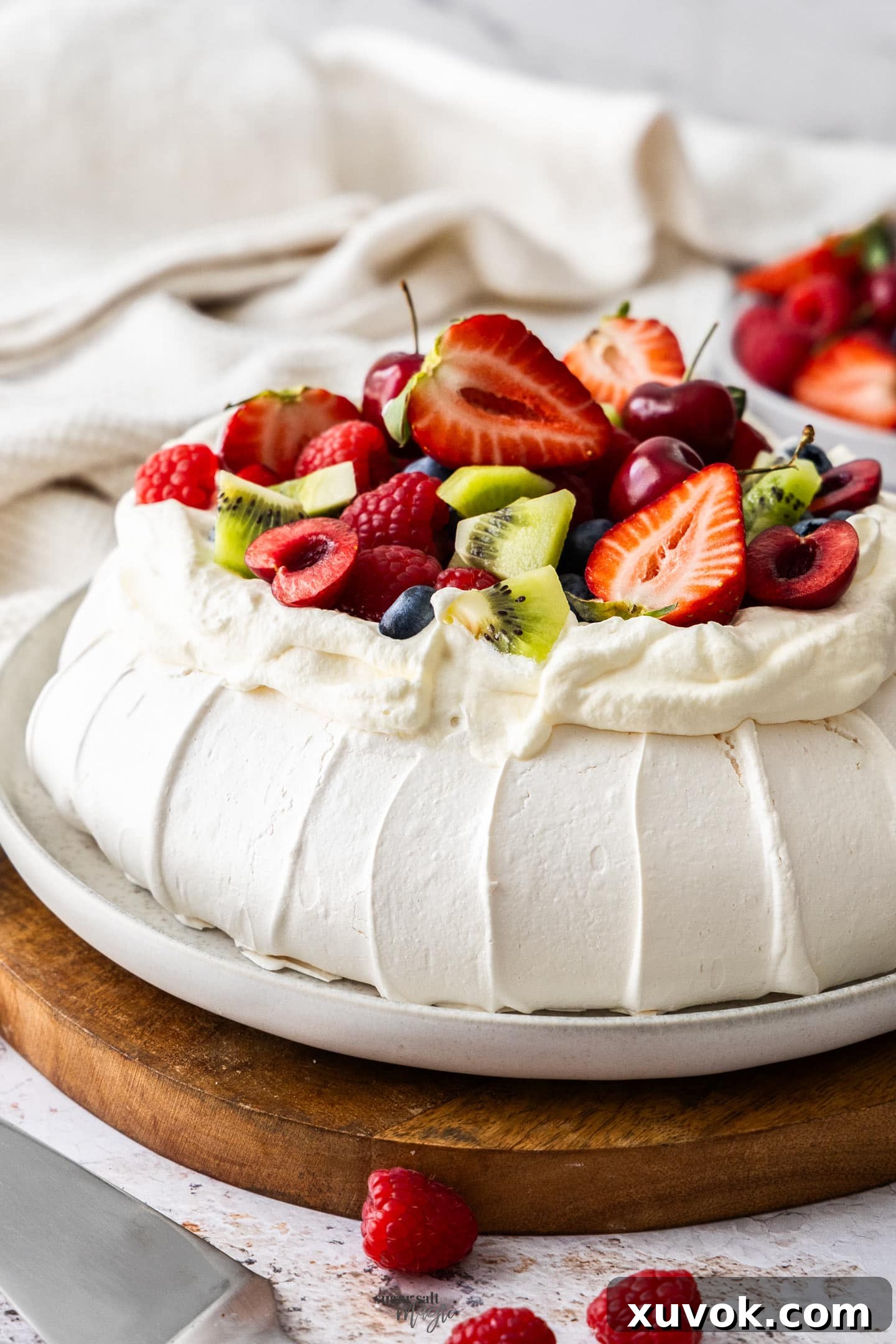
Imagine an ethereal creation: a pristine, crisp meringue shell, yielding to a divinely soft, almost marshmallow-like interior. This delicate structure is then crowned with generous swirls of freshly whipped cream and an abundance of vibrant, seasonal fresh fruit. It’s a symphony of textures and flavors – sweet yet remarkably light, dissolving gracefully on the palate, and undeniably a showstopper that commands attention at any gathering. This classic meringue dessert is perfect for celebrations or a delightful weeknight treat.
Despite its elegant appearance, pavlova shouldn’t intimidate even novice bakers. In fact, crafting this masterpiece is surprisingly straightforward. The very pavlova featured in these photographs was prepared with such ease, I managed to do it while simultaneously brewing coffee and loading the dishwasher! This comprehensive, step-by-step guide is designed to empower you. You’ll not only discover my tried-and-true perfect pavlova recipe, beloved by everyone for years, but also a wealth of essential troubleshooting tips to ensure your success every single time. Get ready to impress your friends and family with this easy pavlova recipe!
For those eager to explore variations, you’ll also adore this Chocolate Pavlova and this delightful mini pavlova grazing board.
This meticulously crafted recipe was originally published on December 5th, 2019, and has since been extensively updated with comprehensive troubleshooting advice and fresh, inspiring imagery to enhance your baking experience.
FEATURED COMMENT
I made this today and it really is the best pavlova I’ve ever made. I make them often and use a Mary Berry recipe which is lovely, but your recipe definitely wins. I topped it with fresh raspberries and passionfruit. Delicious.
Joanne Sykes
A quick note: this post is quite detailed, but please don’t feel overwhelmed! Many aspiring bakers find pavlova a bit daunting, so I’ve included an abundance of valuable tips and comprehensive troubleshooting advice. My goal is to equip you with all the knowledge needed to create a consistently beautiful, show-stopping pavlova every single time you bake. Below, you’ll find a table of contents to easily navigate to the sections most relevant to your needs, whether you’re looking for pavlova ingredients, step-by-step instructions, or solutions to common pavlova problems.
Alternatively, if you’re eager to start baking, feel free to skip directly to the recipe card.
Table of Contents
- What Exactly is Pavlova?
- Where Does the Beloved Pavlova Originate?
- Essential Ingredients for Pavlova
- How to Make the Perfect Pavlova (Step-by-Step Guide)
- Common Pavlova Troubleshooting & Solutions
- My Egg Whites Won’t Whip Properly
- Why Is My Pavlova Flat?
- Why Did My Pavlova Crack?
- My Pavlova Is Stuck to the Paper/Tin
- Why Is My Pavlova Weeping?
- My Pavlova Isn’t White
- Can Pavlova Be Made in Advance?
- Can You Freeze Pavlova?
- How to Decorate a Pavlova
Never Miss a Delicious Recipe!
Get our latest, most delectable recipes delivered straight to your inbox and elevate your home baking!
What Exactly is Pavlova? Unveiling this Ethereal Dessert
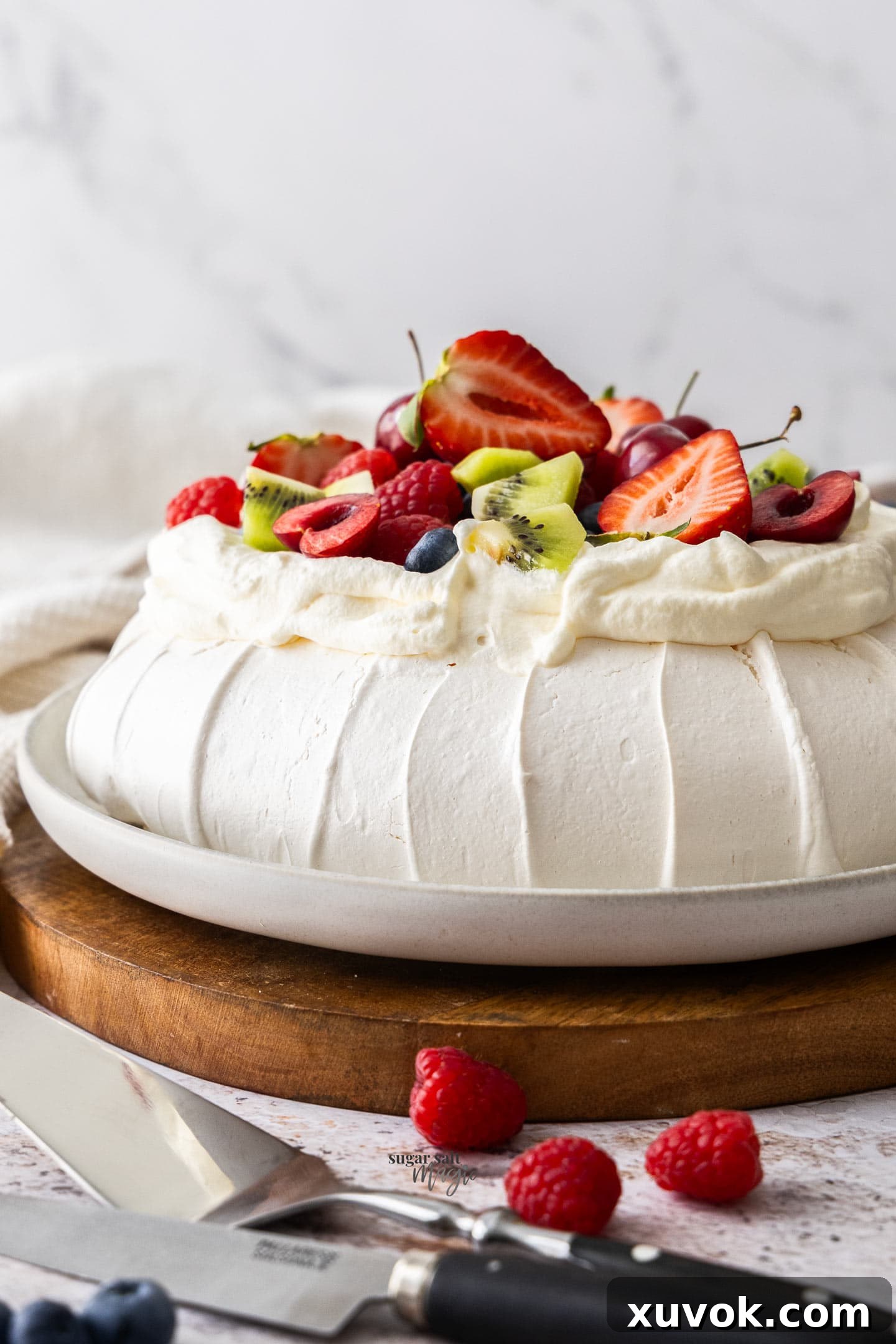
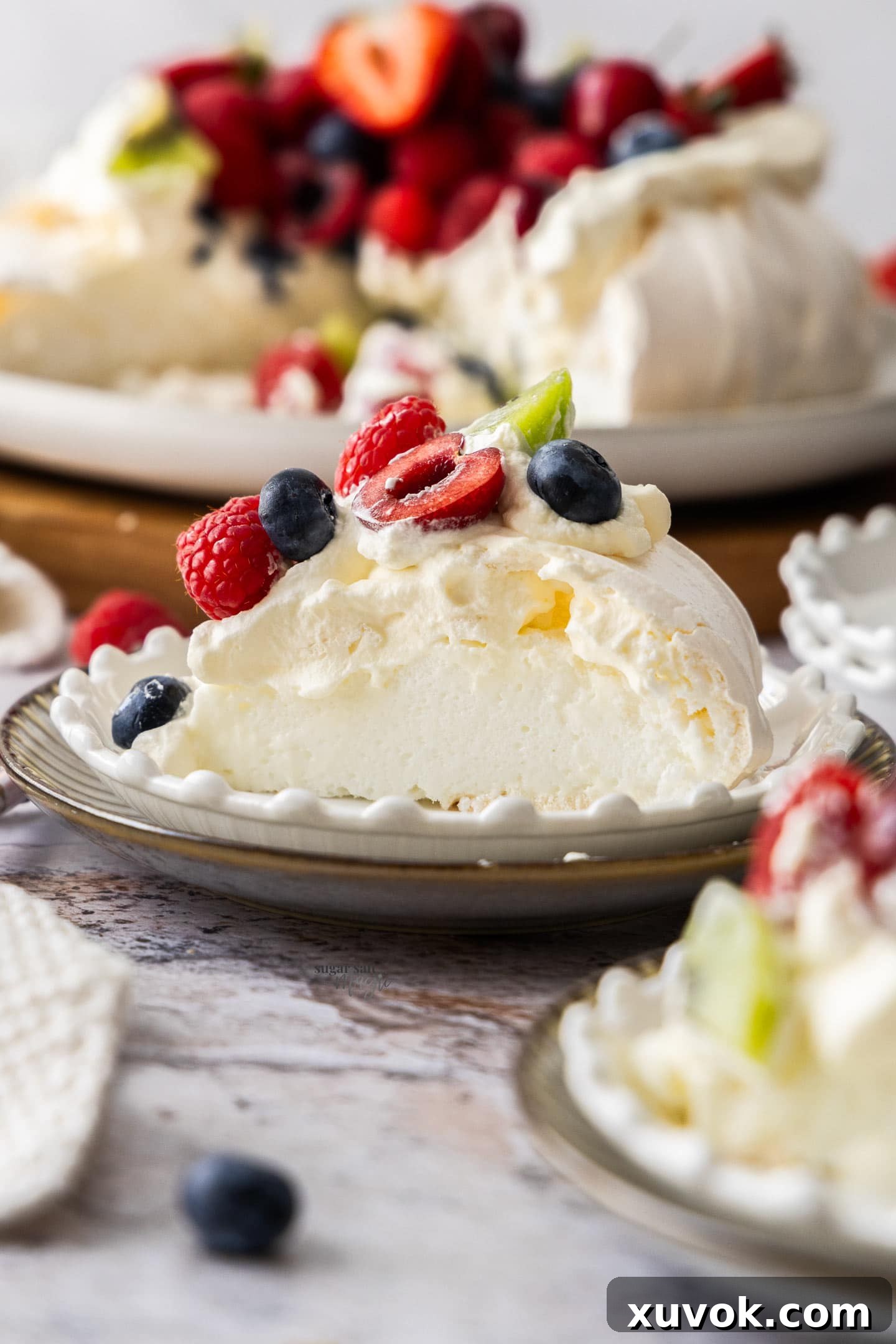
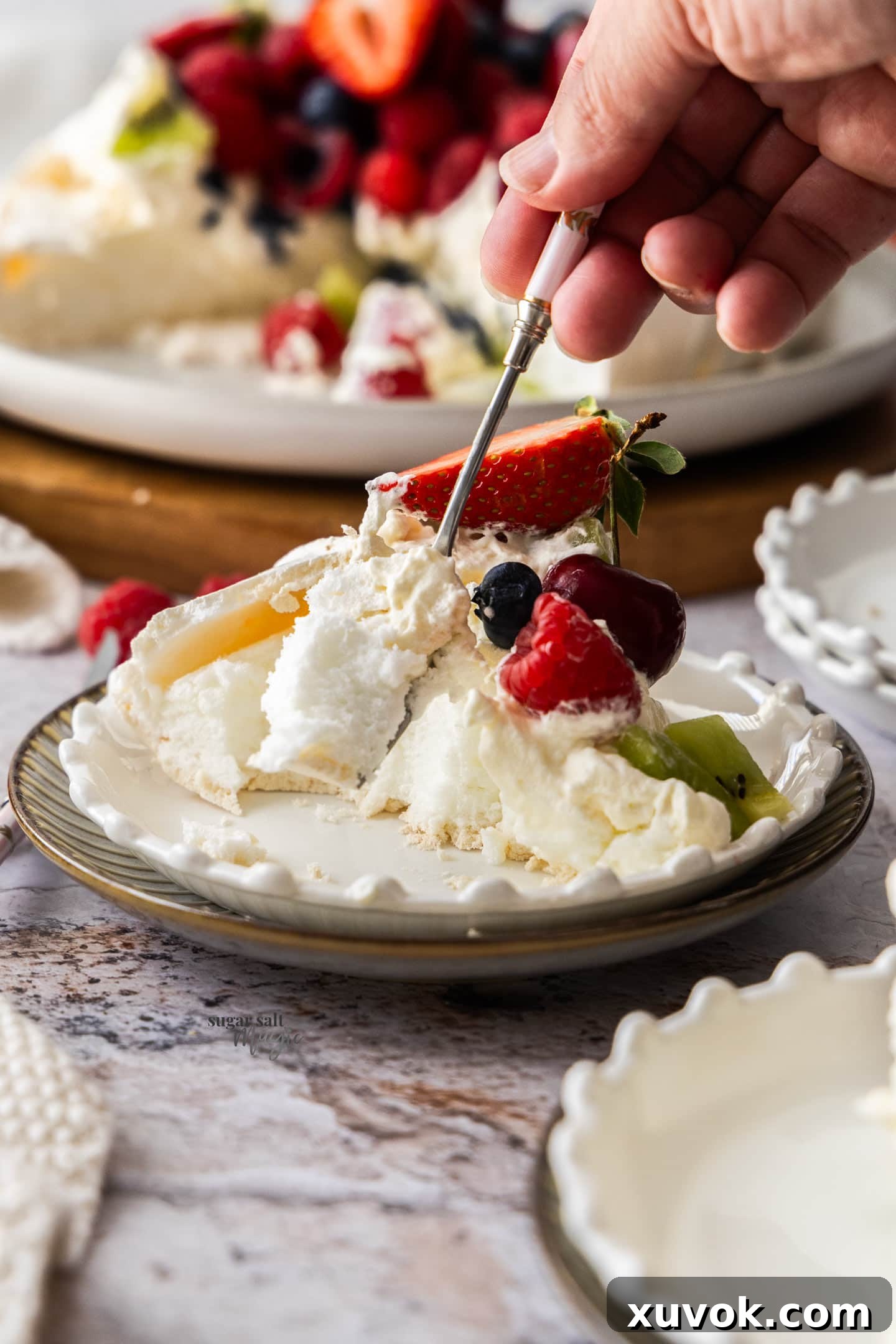
Pavlova is a magnificent dessert crafted from a careful blend of egg whites and sugar, meticulously whipped to achieve stiff, glossy peaks. This cloud-like mixture is then baked at a very low temperature, a crucial step that allows it to dry slowly and form its signature structure. The result is a truly enchanting creation: a delicate, crisp outer crust that encases a wonderfully soft, melt-in-your-mouth marshmallowy center. The quintessential pavlova boasts a pure, pristine white color, eschewing any golden hues, and is renowned for its ethereally light texture that feels almost weightless.
While pavlova shares its primary ingredients with meringue, it distinctively differentiates itself from traditional meringue cookies in one key aspect: its unique interior. Unlike meringue cookies, which are typically crisp and dry all the way through, pavlova is specifically designed to have a luscious, soft, and slightly chewy marshmallow-like center. This delightful contrast between the brittle exterior and the yielding interior is what truly sets pavlova apart, creating a dessert experience that is both elegant and profoundly satisfying. It’s this textural complexity that elevates it from a simple baked meringue to a beloved culinary masterpiece, often served as a showstopping centerpiece.
Where Does the Beloved Pavlova Originate? A Culinary Debate
The origins of this gorgeous dessert are steeped in a friendly, yet passionate, culinary debate between Australia and New Zealand, both nations proudly claiming pavlova as their national dish. This iconic sweet treat was famously created in honor of the legendary Russian ballerina, Anna Pavlova, during her enchanting tours of both countries in the 1920s. While the exact birthplace remains a point of contention among food historians, historical research indicates that the first documented reference to a “pavlova” in its now-familiar form—a large meringue base generously topped with cream and fresh fruit—appears in an Australian article dating back to 1926, suggesting an Australian culinary heritage.
As an Aussie, my vote is unmistakably for Australia. However, regardless of where its roots truly lie, generations of both Kiwis and Australians have grown up with this beautiful dessert gracing their festive tables and celebrations. It’s a culinary staple across both countries, evoking memories of summer gatherings and special occasions. Perhaps, rather than debating its precise origin, we should simply unite in enjoying this delectable creation. After all, the joy of a perfect pavlova is a shared experience that transcends national borders, bringing smiles to faces on both sides of the Tasman with its irresistible charm.
Essential Ingredients for Your Perfect Pavlova
Jump to the recipe card for the full list of ingredients and detailed instructions.
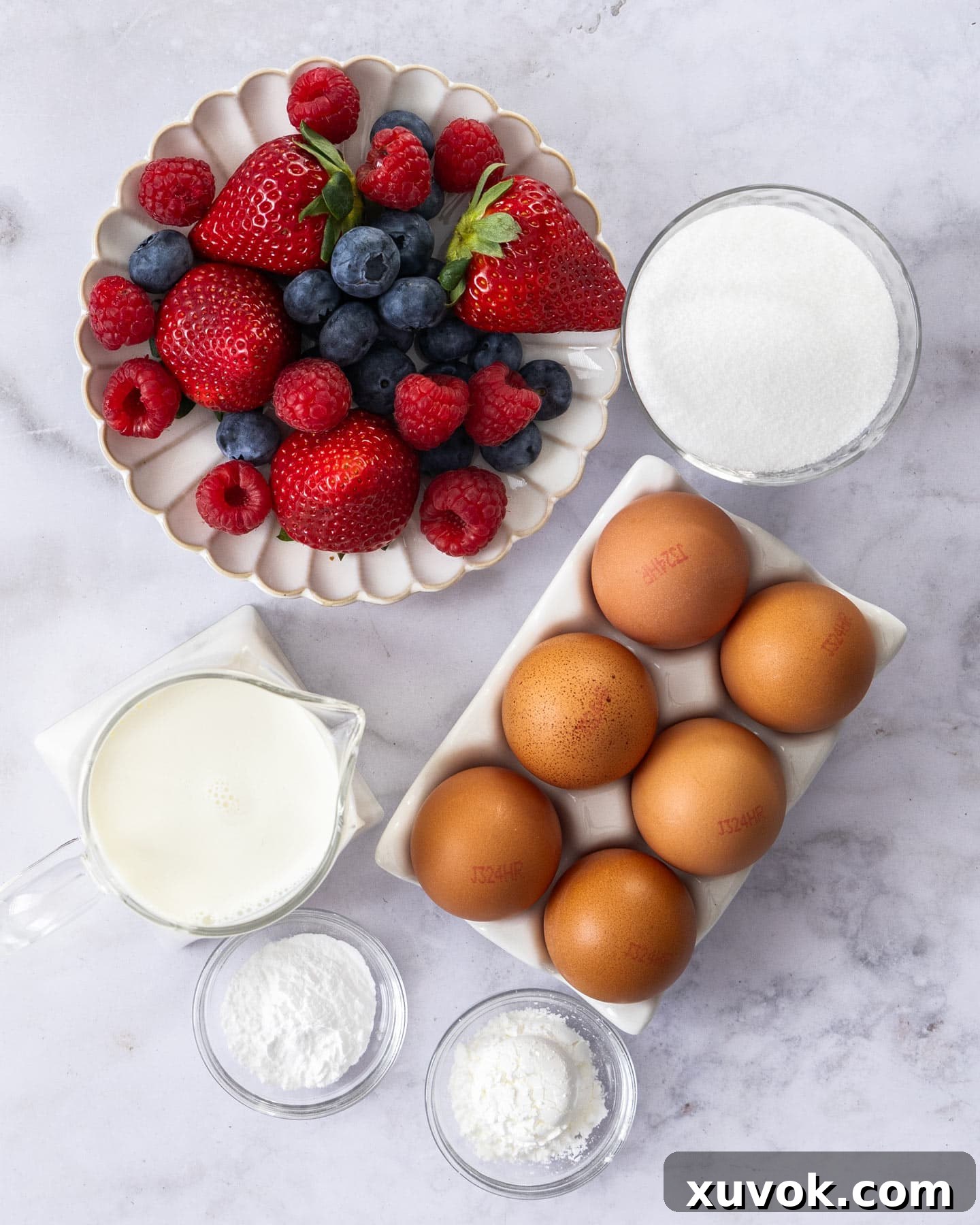
This deceptively simple pavlova recipe relies on a harmonious combination of just four core ingredients, making it accessible yet incredibly rewarding to master:
- Large Egg Whites: These form the foundational structure of your pavlova. Using egg whites from large eggs ensures you get the right volume and protein content necessary to trap air effectively. The albumen (protein) in egg whites denatures and reforms around air bubbles when whipped, creating the meringue’s signature lift and stable structure.
- Caster Sugar (Superfine Sugar): My preference for meringue and pavlova is caster sugar, also known as superfine sugar (not to be confused with powdered sugar/confectioners’ sugar). Its fine granules dissolve quickly and evenly into the egg whites, leading to a smooth, stable meringue without the risk of overbeating. While regular granulated sugar can be used, you must exercise extra caution and patience during mixing to ensure it fully dissolves; undissolved sugar can lead to a sticky, weeping pavlova later on.
- Cornflour (Cornstarch): This humble ingredient is the secret to achieving that characteristic thick, delightfully melt-in-your-mouth marshmallowy center that defines a perfect pavlova. It helps to create a soft, slightly chewy interior while simultaneously reinforcing the crisp exterior, giving pavlova its unique textural contrast.
- Cream of Tartar: A vital stabilizer for egg whites, cream of tartar is an acidic salt that aids in achieving strong, voluminous peaks that hold their shape beautifully. It enhances the meringue’s structure, preventing it from collapsing, and contributes to a whiter, more stable finished product. If you don’t have cream of tartar, you can substitute it 1:1 with white vinegar or fresh lemon juice, which serve the same crucial acidic purpose.
For an extra touch, you might consider adding a teaspoon of vanilla extract and a pinch of salt at the very end of the mixing process. However, in my opinion, the pavlova truly shines with just these four simple ingredients, allowing its natural flavors and textures to come through without distraction. Be mindful that vanilla extract, particularly darker varieties, can sometimes impart a slight golden tinge to the pavlova, compromising its desired pure white appearance. For the whitest result, I often omit it, preferring to infuse flavor into the whipped cream topping instead.
Selecting and Preparing Your Eggs: For optimal results when making pavlova, aim for semi-fresh eggs – meaning they’re a few days old, rather than freshly laid, but certainly not near their expiration date. Older eggs tend to have thinner whites, which whip up to a greater volume more easily. Both cold and room-temperature eggs can be used effectively, though some bakers find room-temperature whites whip faster. When separating them, I highly recommend using your hands. Crack the egg into one hand and gently let the white slip through your fingers into a small bowl, carefully ensuring no speck of yolk contaminates the white. Yolk, being a fat, will prevent the egg whites from whipping properly. Once confirmed clear, transfer the egg white to your main mixing bowl and repeat the process for the remaining eggs.
The Importance of Sugar Choice: As mentioned, use caster or superfine sugar exclusively. Avoid icing sugar, powdered sugar, or confectioners’ sugar, as they contain starches or anti-caking agents that are unsuitable for meringue and can lead to a sticky or unstable result. Granulated white sugar, with its larger crystals, takes much longer to dissolve, significantly increasing the risk of overbeating the egg whites, which can lead to structural issues and a brittle meringue. Brown sugars are also a no-go; their higher moisture content will almost certainly cause your beautiful meringue to “weep” during or after baking, leaving puddles of syrup. Understanding the nuances of different types of sugar is crucial for pavlova success.
How to Make the Perfect Pavlova (A Detailed Step-by-Step Guide)
Are you ready to create the most exquisite pavlova recipe you’ve ever tasted? I’ve meticulously refined this recipe over many years, perfecting the method to consistently achieve a truly showstopping pavlova that will impress everyone with its crisp shell and marshmallowy center.
Jump to the recipe card for the full list of ingredients and precise instructions.
- Ensure Your Equipment is Pristine: This initial step is absolutely critical. Even the slightest trace of fat, grease, or oil can prevent egg whites from whipping into stable peaks. Start by thoroughly washing your mixing bowl (preferably glass or metal, avoid plastic which can retain grease), whisk, and any attachments in hot, soapy water. Rinse them meticulously and dry them completely. For an extra layer of assurance, I often rub a slice of lemon over all surfaces; the acid helps to cut through any invisible residues of fat, leaving your equipment perfectly clean and ready to make a perfect pavlova.
- Accurately Measure Ingredients & Maintain Ratios: Precision is key in baking, especially with pavlova. Measure all your ingredients accurately. If you plan to scale the recipe, consistently adhere to the ideal ratios: ¼ cup egg whites to ½ cup caster sugar to 1 teaspoon cornflour (cornstarch) to ½ teaspoon cream of tartar. This consistency guarantees a successful outcome and prevents common troubleshooting issues.
- Account for Egg Size Variations: Egg sizes can differ significantly, so relying on cup measurements for egg whites is more reliable than counting eggs alone. My recipe calls for ¾ cup of egg whites, which typically equates to the whites from approximately 6 large eggs. This volume will yield a beautifully sized 9-inch round pavlova, standing proudly at about 3.5 inches in height, perfect for a gathering.
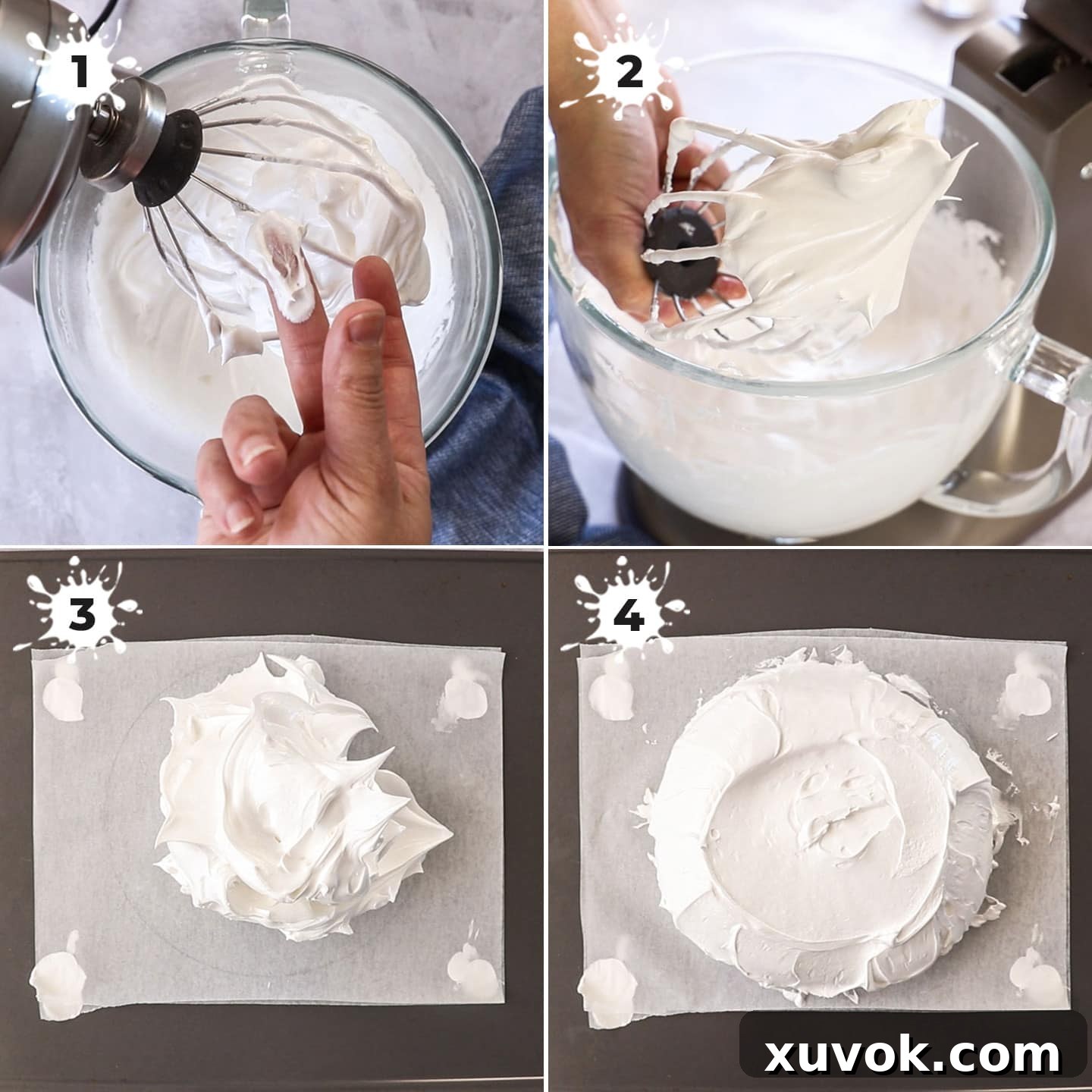
- Whip Egg Whites to Soft Peaks: Begin by whipping your egg whites in a stand mixer fitted with the whisk attachment, or using an electric hand mixer. Start on a low-medium speed. The goal here is to gradually incorporate air until the egg whites reach the “soft peak” stage. This means when you lift the whisk, the peaks will stand up but gently curl over at the tip. At this point, they should be foamy and opaque, ready for sugar incorporation.
- Gradually Add the Sugar: This is a crucial step that demands patience. With the mixer still running, add the caster sugar one tablespoon at a time. After each addition, count slowly to 20 before adding the next spoonful. This deliberate pause allows each sugar crystal ample time to dissolve completely into the egg whites, preventing a gritty texture and ensuring a stable meringue that won’t weep. Rushing this step is a common pitfall in pavlova recipes.
- Achieve Stiff, Glossy Peaks: Once all the sugar has been incorporated, increase the mixer speed to medium-high (avoiding the absolute highest setting, which can overbeat the meringue too quickly). Continue whisking until the meringue becomes incredibly thick, voluminous, and wonderfully glossy. To test for stiff peaks, lift the beater; the meringue should stand straight up without drooping. For a final check, rub a tiny bit of meringue between your fingertips – it should feel perfectly smooth, with no discernible sugar granules. If you still feel grittiness, continue mixing for another minute or so until smooth. This ensures your pavlova holds its shape.
- Gently Fold in Cornflour and Cream of Tartar: As the very final step in mixing, sift the cornflour and cream of tartar (and any optional clear vanilla extract) over the stiff meringue. Whisk gently for only a few seconds, just long enough to ensure these stabilizers are evenly incorporated without deflating the precious air you’ve built into the meringue. Overmixing at this stage can lead to a flat pavlova.
- Prepare Your Baking Tray: Select a flat baking tray without raised sides, or a large baking sheet. This design makes it significantly easier to transfer and remove your delicate pavlova once it has cooled. On a piece of baking paper (parchment paper), draw an 8-inch circle using a non-toxic pencil. Flip the paper over so the pencil mark is underneath. Dab small amounts of meringue mixture on each corner of the paper to secure it to your baking tray, preventing it from sliding during shaping.
- Carefully Transfer the Meringue: When moving the meringue mixture from the bowl to your prepared tray, exercise extreme gentleness. It’s paramount not to bash or aggressively handle the meringue, as this can knock out the air you’ve painstakingly incorporated, leading to a flat and dense pavlova.
- Expertly Shape Your Pavlova: Using a silicone spatula or an offset spatula, spoon the meringue mixture onto the center of your baking paper, using the drawn circle as your guide. Gently and evenly spread the meringue within the circle, aiming for consistent thickness. Next, create nice strong walls by making gentle, sweeping motions from the bottom upwards around the sides of the circle. This provides structural integrity. Finally, form a shallow well or “nest” in the top center of the pavlova, leaving about 2 inches of the side walls at their original height. This well will perfectly cradle your delicious toppings later.
- Bake at the Correct Temperature: Preheat your oven accurately to 120°C (110°C fan-forced) / 245°F. Place the shaped pavlova gently into the preheated oven and bake for precisely 90 minutes. Maintaining a low, consistent temperature is crucial for drying out the meringue without browning it, ensuring a pristine white pavlova.
- Crucial Slow Cooling Process: After the 90-minute baking time is complete, turn off your oven. Critically, leave the pavlova inside the closed oven for a minimum of 2 hours, or ideally, even overnight. This extended, slow cooling period is absolutely vital. It allows the pavlova to dry out further, solidify its structure, and prevents sudden temperature changes that could cause it to crack extensively. This step is key to preventing a cracked pavlova.
- Thoughtfully Top Your Pavlova: As tempting as it may be to pile on generous amounts of toppings, resist the urge to overload your pavlova. The delicate crust, while firm, can be fragile and may crack under excessive weight. For the freshest and best presentation, always delay decorating your pavlova until the very last minute, just before serving. This not only preserves the crispness of the meringue but also prevents the base from becoming soggy or “melting” due to contact with wet ingredients like cream or fruit juices.
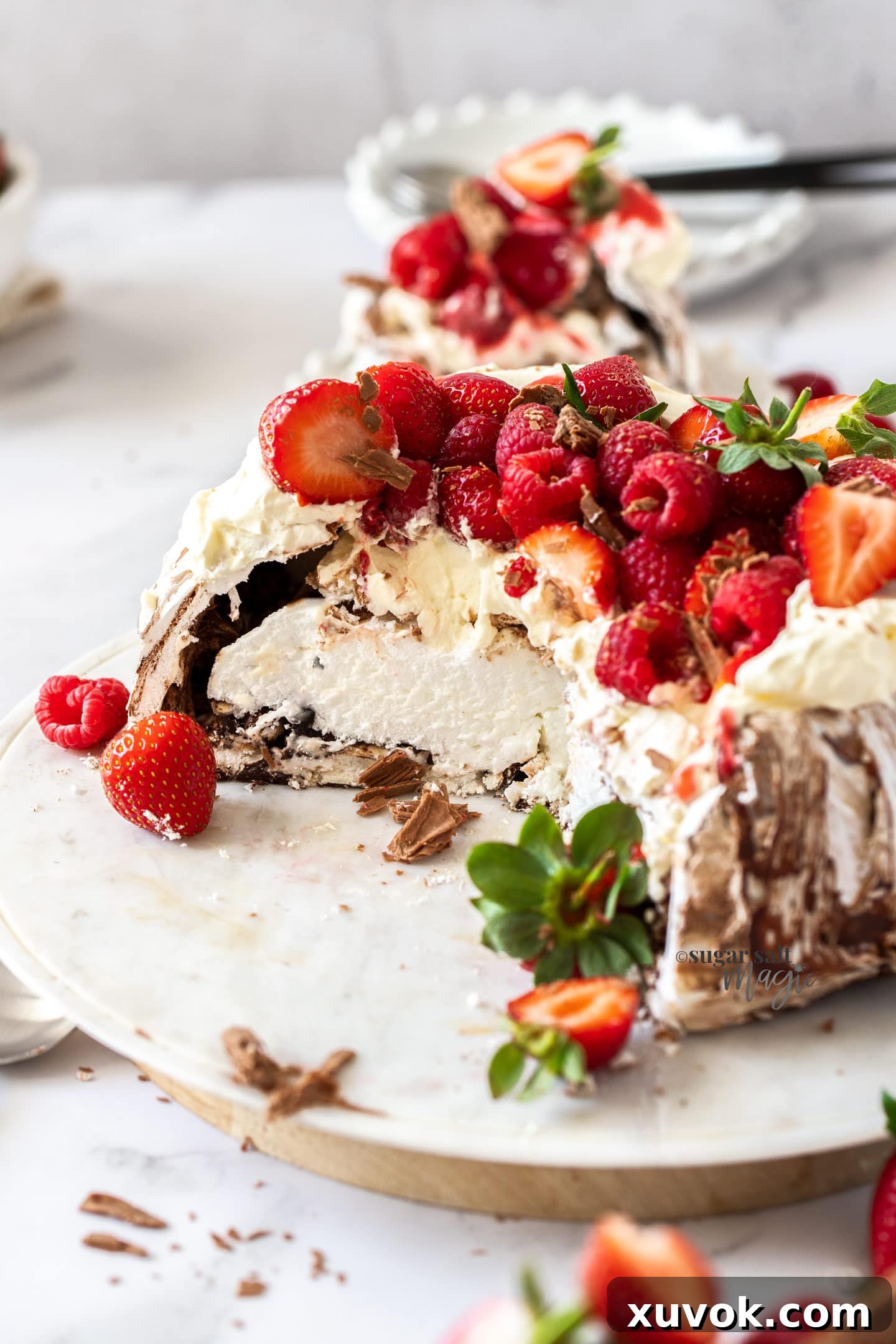
Allowing your pavlova to cool slowly inside the turned-off oven for several hours after baking serves a dual purpose: it permits the meringue to continue drying out while gradually bringing it to room temperature. This gradual cooling is key to preventing those common, unsightly cracks that can mar an otherwise perfect pavlova. I find it particularly convenient to bake my pavlova in the evening before an event, then simply leave it in the oven overnight to cool completely. This method ensures it’s perfectly crisp, stable, and ready for decoration the next day, making it an ideal make-ahead dessert.
Common Pavlova Troubleshooting & Easy Solutions
Even with the best intentions and adherence to a reliable pavlova recipe, baking can sometimes present minor challenges. Don’t despair! Here are comprehensive solutions to the most common issues you might encounter when baking pavlova, ensuring your dessert is always a success, from preventing a flat pavlova to fixing a weeping meringue.
My Egg Whites Won’t Whip to Stiff Peaks
The Solution: Egg whites are highly sensitive to fats. Any trace of oil, grease, or egg yolk will prevent them from achieving the necessary volume and stability required for a successful meringue.
This is why meticulous preparation is paramount for pavlova success. Before you even crack an egg, make absolutely certain that all your equipment – including your mixing bowl (ideally glass or stainless steel, as plastic can sometimes retain fatty residues), whisk, and any attachments – is spotlessly clean and thoroughly dry. Even a microscopic amount of residual grease from previous baking, or an accidental drop of egg yolk during separation, can sabotage your efforts. If this happens, it’s best to discard the whites and start fresh with new eggs and re-cleaned equipment. Using a lemon half to rub down your bowl and whisk before drying can help eliminate hidden fatty residues, ensuring optimal conditions for whipping egg whites.
Why Is My Pavlova Flat and Lacking Volume?
The Solution: This usually points to egg whites not being whipped to adequate stiff peaks, or the meringue mixture losing its trapped air before baking.
The voluminous, airy structure of pavlova comes from the air meticulously whipped into the egg whites. It’s crucial to continue whisking until the egg whites form truly stiff peaks – meaning they stand upright without any drooping when the whisk is lifted. If the meringue hasn’t reached this stage, it simply won’t have the internal structure to hold its shape during baking, resulting in a flat pavlova. Furthermore, once you’ve achieved those beautiful stiff peaks, handle the meringue mixture with extreme gentleness. Aggressive folding, stirring, or shaping can easily knock out the trapped air, causing your pavlova to deflate and bake flat. If you’re adding any flavorings (such as clear extracts), incorporate them very briefly at the end, as excess moisture can also contribute to deflation.
Why Did My Pavlova Crack?
The Solution: Cracking can stem from several factors, including rough handling, omitting acidic stabilizers, baking or cooling too rapidly, or even overbeating the egg whites.
Rough Handling: It’s essential to remember that pavlovas are inherently delicate and wonderfully light creations. They are not designed to be robust feats of structural engineering like a heavily decorated layer cake. Treat them with care throughout the entire process, from shaping to moving to serving. And critically, avoid overloading your pavlova with excessive or heavy toppings. The sheer weight can stress the delicate meringue shell, causing it to crack. For instance, the pavlova pictured in these photos, while beautiful, did develop some cracks after being heavily loaded with fruit for photography. This is perfectly normal and does not detract from its beauty, texture, or delicious taste. Don’t let anyone tell you a pavlova “shouldn’t” crack – a few hairline fissures are part of its rustic charm and a sign of its delicate nature.
Forgetting the Acid: Ingredients like cream of tartar, white vinegar, or lemon juice are not just optional additions; they play a vital role in pavlova’s success. These acidic components stabilize the egg whites, reinforcing their protein structure. This enhanced stability ensures the meringue holds its form more effectively during the baking process, significantly reducing the likelihood of cracking and providing a robust structure.
Baked or Cooled Too Quickly: Patience is a virtue in pavlova making. Resist the temptation to increase the oven temperature to speed up baking; this can lead to rapid expansion and cracking. Similarly, removing the pavlova from the oven too soon or cooling it abruptly can cause a thermal shock (a sudden temperature drop), leading to significant cracks. The slow, undisturbed cooling process within the turned-off oven is crucial for gradual contraction and stabilization, preventing a cracked pavlova.
Overbeaten Eggs: It is indeed possible to overbeat egg whites, both before and after adding the sugar. Overbeaten egg whites become dry, granular, and brittle, losing their elasticity, which can make the meringue more prone to cracking during baking. To prevent this, closely monitor your egg whites. Whip them just until soft peaks form before gradually incorporating the sugar. After the sugar is added, continue beating only until firm, glossy, stiff peaks are achieved and the sugar is fully dissolved. Using superfine (caster) sugar helps, as it dissolves more quickly, reducing the beating time. Also, consider starting at a lower speed, then increasing to medium-high only after the sugar has been incorporated, rather than whisking on the highest setting throughout.
My Pavlova Is Stuck to the Paper or Tin
The Solution: A sticky base is almost always a sign of the pavlova not being thoroughly baked or dried out sufficiently.
If your pavlova hasn’t been baked for the full recommended time, or if it hasn’t had adequate time to dry out and cool slowly in the oven afterwards, its base will retain too much moisture. This excess moisture prevents it from cleanly releasing from the baking paper or tin. Ensure you bake the pavlova for the precise duration specified in the recipe. Crucially, allow it to remain in the turned-off oven for the full cooling period. Attempting to remove it prematurely will not only risk it sticking but can also cause the delicate structure to crack or tear as you try to peel away the paper. Patience during the drying and cooling phase is truly rewarded with a perfectly released, unblemished pavlova base.
Why Is My Pavlova Weeping? (Sugar Syrup Dripping)
The Solution: Weeping is primarily caused by excess moisture – either from the environment or from undissolved sugar in the meringue.
Environmental Moisture and Humidity: Pavlova is highly susceptible to moisture, particularly high humidity in the air. The sugar within the meringue is hygroscopic, meaning it readily absorbs moisture from the surrounding environment. When it takes on too much moisture, the egg whites can no longer hold it, and it “weeps” out as a syrupy liquid. While weeping might not be an issue in very dry climates, it can be a significant challenge in particularly humid conditions. To mitigate this and prevent a weeping pavlova:
- Consider making your pavlova in the evening and letting it sit in the turned-off oven to dry out overnight. The oven acts as a sealed, dry environment, protecting it from ambient humidity.
- If you have refrigerated air conditioning, turn it on and cool down your kitchen as much as possible before and during the pavlova-making process to reduce ambient humidity levels.
- Avoid using the stove, dishwasher, or any appliance that creates heat or steam in the kitchen immediately prior to or during the baking and cooling of your pavlova, as this increases moisture in the air.
Undissolved Sugar: Sugar crystals that haven’t fully dissolved into the egg whites can also contribute to weeping. These undissolved granules can attract moisture and compromise the meringue’s stability, leading to syrup leakage. To prevent this, always use caster or superfine sugar, as its smaller crystals dissolve much more quickly than regular granulated sugar. After incorporating all the sugar, always test your meringue mixture by rubbing a tiny amount between your thumb and forefinger. If it feels perfectly smooth with no grittiness, your sugar is fully dissolved, and your meringue is ready. If you feel any granules, continue beating until it’s smooth.
My Pavlova Isn’t a Pristine White; It’s Browned or Golden
The Solution: Discoloration is usually a result of baking at too high a temperature, or occasionally, using colored extracts.
Oven Temperature Accuracy: Oven thermostats can often be inaccurate, leading to inconsistent baking results. It’s an excellent practice to keep an oven thermometer in your oven at all times. This allows you to calibrate your oven’s actual temperature to the recipe’s requirement, ensuring accurate low-temperature baking. If your pavlova is turning golden, it’s a clear indication that your oven is too hot. Reduce the temperature slightly to prevent further browning. Furthermore, using the fan-forced (convection) setting, if available, often helps distribute heat more evenly and typically results in a brighter white pavlova compared to conventional heat.
Avoid High Temperatures: Never be tempted to bake your pavlova at a higher temperature in an attempt to shorten the baking time. This strategy invariably leads to rapid browning, caused by the sugar caramelizing, and significantly increases the risk of cracking. A pavlova requires a gentle, low heat to dry out slowly and evenly, preserving its delicate white appearance and marshmallowy center without burning.
Colored Extracts: While minor, slight discoloration can also occur if you incorporate extracts that are not completely clear, such as certain vanilla extracts or almond extracts with a brownish tint. The effect is usually very subtle, but for a truly pristine white pavlova, it’s worth considering. Personally, I find that pavlova doesn’t truly require vanilla extract to be delicious, and by omitting it, I ensure the finished product remains as pristine white as possible. If you desire additional flavors, consider adding them to your freshly whipped cream topping instead, where they won’t affect the meringue’s color.
Can Pavlova Be Made in Advance? Absolutely!
One of the many wonderful qualities of pavlova is that its base can, and often should, be prepared in advance. Making the pavlova base the day before (or even the night before your event) is actually the best approach. My favorite method is to bake it before bed, then leave it undisturbed in the turned-off oven overnight with the door closed. This allows for a very slow, gradual cooling and further drying, which contributes to a perfectly crisp and stable meringue, ideal for a make-ahead dessert.
While a well-made pavlova base can potentially last up to two days, it will gradually absorb moisture from the air, causing it to lose its initial crispness over time. The humidity levels in your environment will directly impact how quickly this happens – a more humid climate will hasten the softening process. To maintain optimal freshness and crispness, store your undecorated pavlova base in an airtight container in a cool, dry place. Crucially, do not store the plain meringue in the refrigerator, as the cold, humid environment of a fridge will cause it to soften and weep very quickly.
Always add the whipped cream and your chosen fresh fruit toppings right before you plan to serve the pavlova. This ensures the toppings are at their best and that the meringue remains wonderfully crisp for your guests, delivering the perfect pavlova experience.
Can You Freeze Pavlova? What You Need to Know
While freezing a pavlova base is generally not the recommended method for preserving its pristine quality, it is technically possible and can be a convenient option in certain situations. However, be aware that a frozen and thawed pavlova will likely not be as perfect as a freshly baked one; the crust can sometimes lose some of its desired crispness and the marshmallowy center might alter slightly. If you choose to freeze, it’s imperative that you freeze only the plain pavlova base, completely without any toppings. I’ve personally had success with pavlovas that have been frozen for no longer than two weeks.
To freeze your pavlova base effectively and maximize its quality upon thawing:
- Ensure it’s Completely Cool: Make absolutely certain your pavlova base has cooled down completely to room temperature before freezing. Any residual warmth can lead to condensation and ice crystals forming on the surface, which will negatively affect the texture.
- Initial Freezing: Carefully place the completely cool pavlova base directly onto its baking tray (or a similar flat surface) and transfer it into the freezer. Allow it to freeze uncovered for a couple of hours until it becomes quite solid and firm. This initial freeze prevents it from sticking to the container later and helps it hold its shape.
- Transfer to Airtight Container: Once solid, very carefully transfer the frozen pavlova base into a rigid, airtight container. This protection is crucial to prevent freezer burn (which dries out food) and shield it from absorbing freezer odors. You can also wrap it carefully in plastic wrap, then foil, before placing it in the container for double protection.
- Thawing: When you’re ready to serve, thaw the frozen pavlova base for a couple of hours at room temperature, keeping it in its airtight container until fully thawed to minimize moisture absorption. Once thawed, proceed with topping and serving as usual. Remember, the texture might be slightly different from a fresh pavlova, but it will still be a delicious treat.
How to Decorate a Pavlova: Unleash Your Creativity
The beauty of decorating a pavlova lies in its simplicity and incredible versatility. The classic and most beloved answer is simply a generous layer of freshly whipped cream, followed by an abundance of whatever fresh fruit is gloriously in season. In Australia, pavlova is a quintessential summer dessert, making vibrant fresh berries (strawberries, blueberries, raspberries), succulent mango, or tangy kiwi fruit perfect choices that burst with flavor and color.
To add an extra layer of visual appeal and flavor complexity, consider incorporating pomegranate arils or the juicy, tangy pulp of passionfruit for a delightful drizzle of color and intriguing texture. For a sophisticated pairing, delicate curls or elegant shavings of dark chocolate complement strawberries and raspberries beautifully, adding a touch of richness. If you’re opting for tropical flavors, toasted flakes of coconut and a hint of bright lime zest pair exquisitely with ripe mango, creating a truly refreshing combination.
Don’t limit yourself to just fresh fruit! You can also experiment with luscious fruit curds. Try a vibrant lemon curd, a zesty lime curd, or a wonderfully aromatic passionfruit curd to fill the pavlova’s center before adding your cream and fruit, elevating the dessert with a tangy contrast. For a festive touch, if you’re making a Christmas pavlova, embrace the seasonal spirit with bright red cherries or tart cranberries, depending on your region, perhaps with a sprinkle of edible glitter for extra sparkle.
Remember, the goal is to enhance, not overpower, the pavlova’s delicate flavor and texture. Choose toppings that offer a balance of sweetness, tartness, and visual appeal, making each slice a truly unforgettable experience and a testament to your perfect pavlova.
Pavlova is an incredibly beautiful, light dessert that is perfect for any occasion. With all these comprehensive tips and tricks, you are now fully equipped to master the art of pavlova making and create this stunning dessert perfectly every single time. Enjoy the magic of this Australian dessert!
More Delicious Recipes You’ll Love
- Mini Pavlova Grazing Board
- Pavlova Roll (Meringue Roulade)
- Mango Pavlova
- Pavlova Wreath
- Chocolate Meringue Cake
- Fluffy Vanilla Cake from Scratch
- Easy Peppermint Meringues
- Mini Lemon Meringue Pies
- Swirled Chocolate Meringues
⭐⭐⭐⭐⭐
Did you try this easy pavlova recipe? Show it some love in the comments section below!
Hungry for more? Subscribe to our newsletter for free recipes straight to your inbox. Also, follow along on Facebook, Pinterest and Instagram.
The Perfect Pavlova Recipe
NOTE: Please consider the cooling time. For best results, it’s highly recommended to make the pavlova base the night before.
Rate Recipe
Pin Recipe
Video
Ingredients
- ¾ cup egg whites (approximately 6 large eggs), room temp (175g/6.2oz)
- 1 ½ cups caster sugar (superfine sugar) (300g / 10.5oz) (see notes)
- 3 teaspoons corn flour (US cornstarch)
- 1 ½ teaspoons cream of tartar (see notes 3)
- ¾ cup whipping cream (or heavy cream)
- 2 cups mixed fresh fruit (for topping, see notes)
For best results, always weigh ingredients where a weight is provided.
Equipment
-
Flat cookie trays or large baking sheet
-
Silicone spatulas
-
Stand mixer with whisk attachment or handheld electric beater
-
Oven thermometer (recommended for accuracy)
Instructions
-
Preheat oven to 120°C (110°C fan forced) / 245°F. Using a non-toxic pencil, trace around the base of an 8-inch cake pan onto a sheet of baking paper (parchment paper).
-
In a clean stand mixer bowl with the whisk attachment (or using a handheld electric beater), beat the egg whites on low-medium speed until they reach the soft peak stage. This should take approximately 5 minutes.
-
Gradually add the caster sugar, one tablespoon at a time, counting slowly to 20 after each addition to allow it to dissolve. Once all the sugar is added, increase the speed to medium-high (do not use the highest setting). Continue whisking until the egg whites are thick, glossy, and at stiff peak stage. To test, rub a small amount between your finger and thumb; it should feel perfectly smooth, not gritty. If grainy, continue beating until smooth.
-
Sift the cornflour and cream of tartar over the meringue. Whisk gently for just a few seconds, only long enough to incorporate them without deflating the meringue.
-
Flip your baking paper so the pencil mark is underneath. Dot small amounts of meringue mixture on each corner of the paper to adhere it to a large baking sheet.
-
Use a spatula to spoon the meringue mixture onto the prepared baking tray. Gently coax it into a circular shape, following the drawn line as a guide. Then, make small, upward sweeping motions from the base to the top all around the sides to create strong walls. Finally, create a shallow well or dent in the center of the top, leaving the outer edge about 2 inches high.
-
Place the tray in the preheated oven and bake for 1 ½ hours. After baking, turn the oven off and leave the pavlova inside, undisturbed, for at least 2 hours (refer to notes for overnight cooling). This slow cooling is vital for preventing cracks.
-
Once completely cool and as close to serving as possible, prepare your toppings. Simply whip the cream with an electric mixer until it reaches just barely stiff peaks. Gently transfer the cooled pavlova to a serving plate, then spread the whipped cream evenly over the top, filling the well. Carefully arrange your mixed fresh fruit on top and serve immediately.
-
Please take a moment to leave a comment & rating. Your feedback is greatly appreciated and incredibly helpful to us.
Notes
- All ovens can vary. If you observe your pavlova turning golden during baking, it indicates the oven temperature might be too high; reduce it slightly. Using the fan-forced (convection) setting often contributes to a more pristine white pavlova.
- Do not use icing sugar (powdered sugar), granulated sugar, or brown sugar. For a perfect pavlova, only use caster or superfine sugar, as its fine crystals dissolve efficiently without overbeating the egg whites.
- Cream of tartar can be substituted 1:1 with white vinegar or fresh lemon juice, both serving as excellent stabilizers for the egg whites.
- For topping inspiration, choose fresh fruits that are in season. Classic choices include strawberries, kiwi fruit, passionfruit, and mango. However, feel free to experiment with blueberries, blackberries, lemon or lime zest, or even thin slices of citrus fruits for a gourmet touch.
- You can conveniently bake your pavlova in the evening and leave it to cool completely in the turned-off oven overnight. This slow cooling method is ideal for preventing cracks and achieving a crisp finish.
- For further detailed guidance and solutions, refer to the comprehensive tips, tricks, and troubleshooting section provided earlier in this post.
IN THE POST
These links will take you to specific sections within this article for more information. Scroll to the bottom of that section to easily return to the recipe card.
- Troubleshooting Your Pavlova
- Egg Whites Won’t Whip
- Flat Pavlova
- Cracked Pavlova
- Pavlova Stuck to Paper/Tin
- Weeping Pavlova
- Discolored Pavlova (Not White)
- Freezing Pavlova
- Decorating Pavlova Ideas
EXPLORE MORE PAVLOVA AND MERINGUE RECIPES
Calories from Fat 72