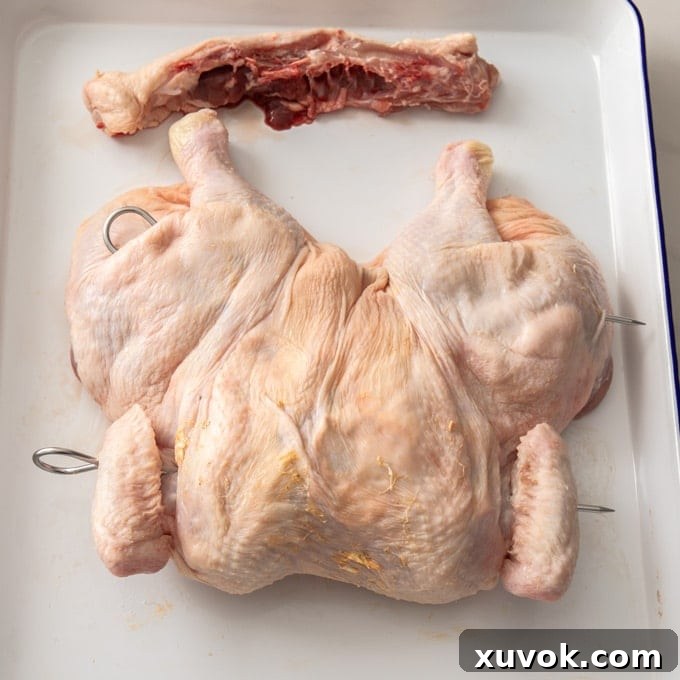
Transform your cooking with a technique that promises juicier meat, incredibly crispy skin, and significantly faster cooking times. Whether you call it spatchcock chicken or butterflied chicken, this simple method involves removing the backbone and flattening the bird before cooking. It’s a game-changer for anyone looking to elevate their chicken dishes, making them more flavorful and consistently cooked.
Mastering how to spatchcock a chicken opens up a world of culinary possibilities, from a perfectly roasted Sunday dinner to a show-stopping grilled centerpiece. The benefits are clear and immediately noticeable:
- Faster and More Even Cooking: By flattening the chicken, all parts are exposed to heat simultaneously, eliminating overcooked breasts and undercooked thighs. This reduces overall cooking time by up to 25%, making it ideal for busy weeknights.
- Superior Crispy Skin: A flattened surface ensures that the skin is uniformly exposed to heat, resulting in an irresistibly golden-brown and crackling-crisp exterior every time.
- Enhanced Flavor Absorption: The increased surface area allows marinades, rubs, and seasonings to penetrate more deeply and evenly, infusing every bite with robust flavor.
- Surprisingly Easy Process: Despite its professional-sounding name, butterflying a whole chicken is much simpler than you might imagine, requiring just a few cuts and the right tools.
For years, “Chicken Thursday” has been a staple in my household—a weekly tradition where chicken takes center stage. I love experimenting with different flavors, but one constant that guarantees success is butterflying the chicken. While the process might seem a little daunting at first glance, I’m here to guide you through exactly how to butterfly a chicken, step by easy step, ensuring your results are nothing short of spectacular.
Don’t forget to explore all my other invaluable cooking and baking tips and tricks here to further expand your culinary skills.
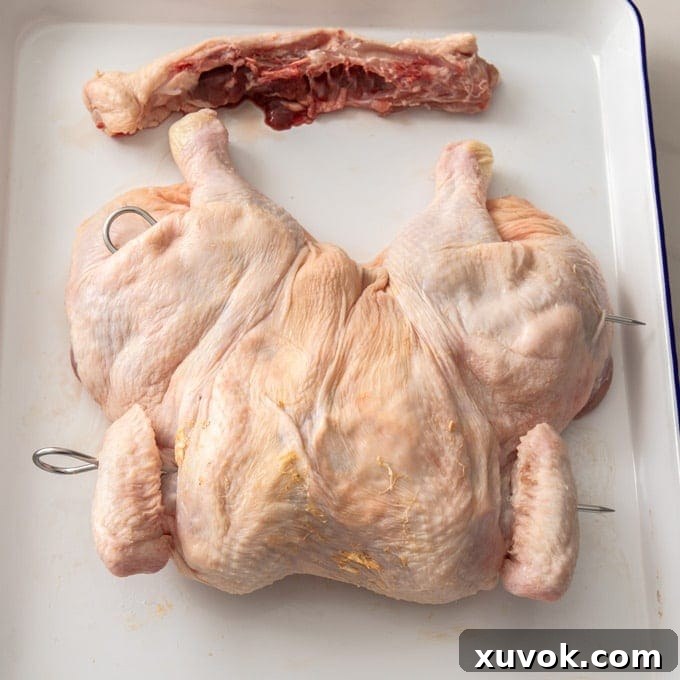
Table of Contents
- What Does It Mean to Spatchcock Chicken?
- Why Butterfly a Whole Chicken? The Benefits Unveiled
- Essential Tools for Spatchcocking
- How to Spatchcock a Chicken (Step-by-Step Guide)
- Preparing Your Spatchcock Chicken for Cooking (Step-by-Step)
- Loosen the Skin for Flavor and Crispiness
- Skewer It for Stability and Evenness
- Pro Tips and Tricks for Perfect Spatchcock Chicken
- Frequently Asked Questions About Spatchcocking
- More Mouthwatering Chicken Recipes You’ll Love
Never Miss a Recipe!
Get the latest recipes straight to your inbox and elevate your home cooking!
What Does It Mean to Spatchcock Chicken?
The terms “spatchcock chicken” and “butterflied chicken” are used interchangeably and refer to the same culinary preparation technique. Essentially, it’s the process of flattening a whole chicken by removing its backbone. This transforms the bird from a bulky, irregular shape into a uniform, flat piece, ready for more efficient and effective cooking. By laying the chicken flat, you maximize its surface area and ensure that heat distributes evenly across the entire bird, leading to superior results.
Why Butterfly a Whole Chicken? The Benefits Unveiled
There are several compelling reasons to embrace the spatchcocking method for your chicken, transforming everyday meals into culinary triumphs:
- Significantly Faster Cooking: When a chicken is flattened, its thickness is uniform, allowing it to cook much faster than a traditionally roasted bird. This means you can get dinner on the table quicker, making it perfect for weeknight meals or when you’re short on time.
- Remarkably Even Cooking: With a conventional whole chicken, the breasts tend to cook faster than the thighs, often resulting in dry breast meat by the time the thighs are done. Spatchcocking ensures that all parts—breast, thighs, and wings—are exposed to the heat source equally, leading to perfectly cooked, juicy meat throughout.
- Unbelievably Crispy Skin: Flattening the chicken maximizes the skin’s exposure to direct heat, promoting superior browning and crisping. Every inch of skin becomes a delectable, golden-brown crust.
- Ideal for Grilling and Roasting: The flat shape makes spatchcock chicken perfect for grilling, as it sits flush against the grates, allowing for even charring and preventing flare-ups. For oven roasting, it fits more easily into a baking sheet and cooks consistently.
- Deeper Flavor Infusion: With a more open, accessible surface, marinades, brines, and rubs can coat the chicken more comprehensively, soaking into the meat and skin for a more profound flavor.
- Easier to Carve: Once cooked, a spatchcock chicken is much simpler to carve into portions, as it lies flat and stable on your cutting board.
Essential Tools for Spatchcocking
First things first: the right tools make all the difference. While a sturdy pair of kitchen scissors might seem adequate, they are often not designed to cut through tough bones without dulling or damaging them. For truly effortless spatchcocking, investing in a good pair of poultry shears is highly recommended. These specialized shears are built with sharp, strong blades and comfortable handles, making quick work of poultry bones. Once you try them, you’ll wonder how you ever managed without them. A reliable chopping board is also essential for a stable and hygienic workspace.
How to Spatchcock a Chicken (Step-by-Step Guide)
Follow these straightforward steps to butterfly a whole chicken with confidence:
- Prepare Your Workspace: Start by placing your chicken breast-side down on a sturdy chopping board. Ensure you have a clean surface and your poultry shears are within reach. Pat the chicken dry with paper towels; this helps with grip and leads to crispier skin later.
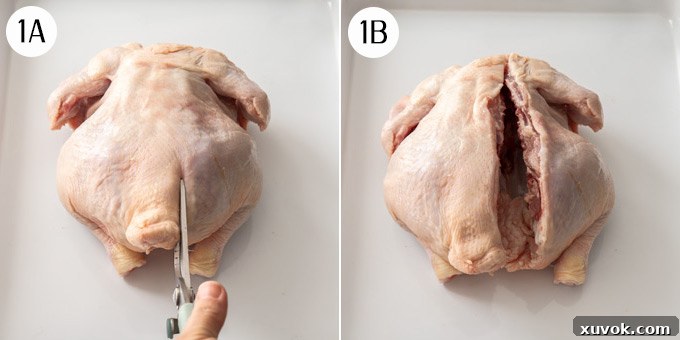
- Locate and Cut Along the Backbone (First Side): Identify the parson’s nose (the tail end) of the chicken. Using your sharp poultry shears (photo 1a), carefully cut along one side of the backbone, from the tail end all the way up to the neck cavity (photo 1b). Apply firm, steady pressure, guiding the shears through the ribs and cartilage.
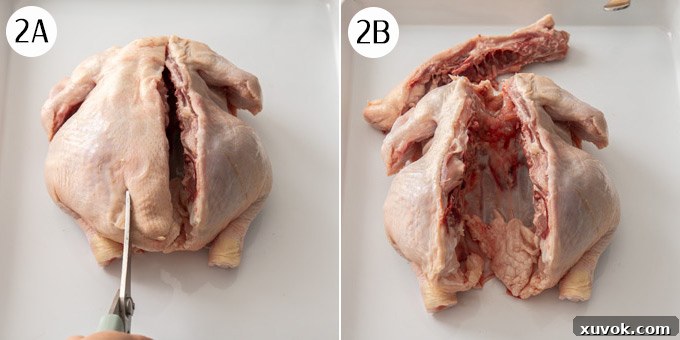
- Remove the Backbone (Second Side): Now, move to the other side of the backbone. Use your shears to cut along the second side, mirroring your first cut (photo 2a). This will completely detach the backbone from the chicken. You can discard the backbone, or better yet, save it to make a flavorful homemade chicken stock (photo 2b). Personally, I sometimes leave the parson’s nose attached to one side if my family enjoys it, saving a cut while still achieving the desired flattening.
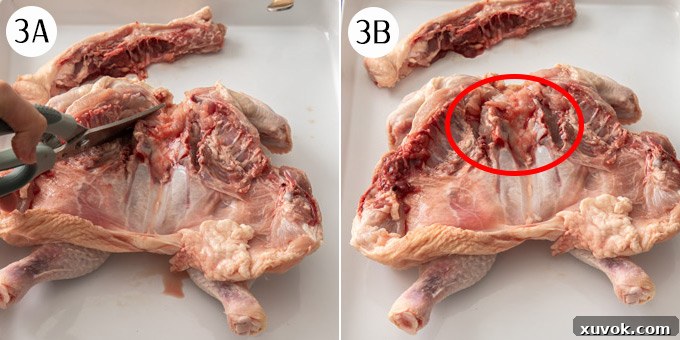
- Optional: Cut the Collarbone for Larger Birds: For smaller chickens, you might be able to skip this step. However, larger birds benefit from an additional cut to help them lie perfectly flat. Press the chicken open slightly to identify the collarbone (sometimes called the wishbone or keel bone). This thick bone is located between the wing and the breastbone on each side (photo 3a). Carefully snip through this bone with your shears. This extra cut releases tension and allows the breast to flatten more effectively (photo 3b).
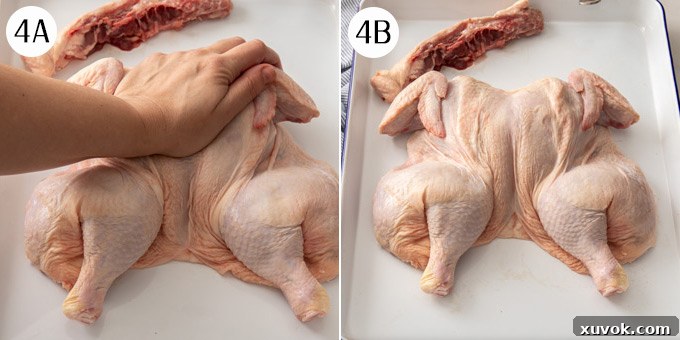
- Flatten the Chicken: Flip the bird back over so it is breast-side up. Open it up like a book, pressing firmly on the breastbone with the heels of your hands (photo 4a). You should hear a distinct crack as the breastbone breaks and the chicken flattens out completely (photo 4b). Ensure the legs are also flattened outwards. If you skipped cutting the collarbone on a smaller bird, this step will likely break those bones too, achieving the desired flat shape.
That’s it! You’ve successfully butterflied a whole chicken. See? It’s much easier than it sounds, and now you’re ready for the next delicious steps.
Preparing Your Spatchcock Chicken for Cooking (Step-by-Step)
Once your chicken is spatchcocked, a few additional steps can further enhance its flavor and texture, ensuring an unforgettable meal.
Loosen the Skin for Flavor and Crispiness
This simple technique creates a pocket under the skin, perfect for infusing flavor and promoting extra crispy skin without needing to remove the skin entirely.
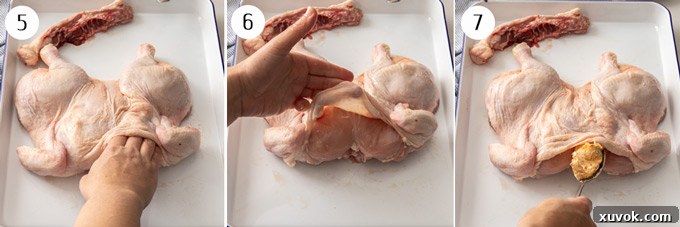
- Gently Create the Pocket: Starting from the neck or wing end of the chicken (where the skin is less prone to tearing), carefully slide your fingers under the skin (photo 5).
- Work Your Hand Under the Skin: Gently work your hand over the breast and thigh areas, separating the skin from the meat. Be mindful not to poke any holes in the skin, as this can prevent it from crisping evenly (photo 6).
- Add Flavor Enhancers: Now you have a perfect pocket to stuff with flavorful ingredients! Compound butters (herb butter, garlic butter, or my delicious pesto butter) are excellent choices. This not only adds moisture and flavor directly to the meat but also helps the skin crisp up beautifully (photo 7).
Try my pesto butter for a truly delicious and aromatic infusion.
Skewer It for Stability and Evenness
If you’re planning to grill or barbecue your spatchcock chicken, skewering it is a brilliant trick. It prevents the chicken from flopping around, making it much easier to handle, flip, and ensures it maintains its flat shape for even cooking.
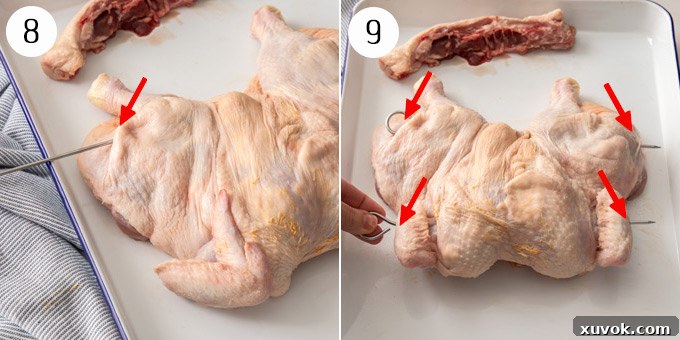
- Secure the Lower Half: Begin by pushing a long metal skewer horizontally through the thickest part of one thigh (photo 8), continuing through the drumstick, then through the tail section (where the backbone used to be), and out through the opposite drumstick and thigh. This creates a stable lower base.
- Stabilize the Upper Half: Tuck the wing tips under the main part of the wing (this prevents them from burning). Then, push another skewer through the middle section of one wing, through the breast meat, and out through the middle of the other wing (photo 9). This ensures the entire bird is held securely in its flattened position.
Pro Tips and Tricks for Perfect Spatchcock Chicken
- Always Use the Right Tools: As mentioned earlier, a sharp pair of poultry shears is your best friend when spatchcocking. They are specifically designed to cut through bone with ease and safety. If you’re using a chef’s knife, ensure it’s very sharp and use a stable cutting board.
- Save the Backbone for Broth: Don’t let that backbone go to waste! It’s packed with flavor and makes an incredible base for homemade chicken broth or stock. You can use it immediately or freeze it for future use. A rich homemade stock is far superior to store-bought and is perfect for soups, sauces, and gravies.
- Consider a Brine for Extra Juiciness: While not strictly required, brining your chicken before spatchcocking can dramatically increase its moisture content, resulting in incredibly juicy, tender meat. A simple brine typically consists of water, salt, sugar, and optional aromatics like bay leaves, peppercorns, herbs (thyme, rosemary), and citrus peel. Brine the whole chicken for 8-12 hours in the refrigerator. My pork brine recipe works wonderfully for chicken too!
- Pat Dry for Maximum Crispness: After brining or rinsing, always pat your chicken thoroughly dry with paper towels. Excess moisture on the skin will steam rather than crisp, preventing that coveted crackling texture.
- Season Generously and Strategically: Don’t be shy with your seasonings. Apply rubs or marinades not only over the skin but also under the loosened skin (as described above) to infuse flavor directly into the breast meat.
- Monitor Internal Temperature: The best way to ensure your chicken is perfectly cooked and safe to eat is to use a meat thermometer. The thickest part of the thigh (without touching bone) should reach 165°F (74°C).
- Rest Your Chicken: After cooking, tent the chicken loosely with foil and let it rest for 10-15 minutes before carving. This allows the juices to redistribute throughout the meat, keeping it moist and tender.
Frequently Asked Questions About Spatchcocking
For roasting in the oven, I recommend cooking your spatchcock chicken at a high temperature, around 200°C (395°F). This high heat helps achieve that desired crispy skin and cooks the bird efficiently. Ensure your oven is fully preheated before placing the chicken in. Baking time will vary depending on the size of your bird, typically ranging from 45-75 minutes. Always use a meat thermometer to ensure the thickest part of the thigh reaches 165°F (74°C).
Absolutely, yes! This is one of the primary benefits of spatchcocking. By flattening the chicken, you increase its surface area and create a more uniform thickness, allowing for much more efficient heat transfer. You can expect your spatchcock chicken to cook approximately 25% faster than a traditional whole roasted chicken, making it a fantastic time-saver.
While poultry shears are highly recommended, you can still spatchcock a chicken using a very sharp, sturdy chef’s knife or even a serrated knife. Lay the chicken breast-side down, locate the backbone, and carefully cut along both sides. Use a rocking motion and apply firm, even pressure. Be extra cautious as knives can slip, and ensure your cutting board is stable. Some find it easier to use the knife to score alongside the backbone, then press down firmly to break through the ribs.
Yes, you absolutely can! If you’re not cooking your spatchcocked chicken immediately, wrap it tightly in plastic wrap and then in aluminum foil or place it in a freezer-safe bag. It can be stored in the freezer for up to 3-6 months. Thaw overnight in the refrigerator before cooking.
Don’t discard it! The backbone is perfect for making homemade chicken stock. Simply simmer it with some aromatic vegetables (like carrots, celery, onion), herbs, and water for a few hours. The resulting stock will be incredibly flavorful and far superior to store-bought varieties for use in soups, sauces, and risottos.
There you have it—all the essential tips and techniques you need to master how to spatchcock a chicken, transforming your poultry dishes forever. This method promises a perfect balance of crispy skin, succulent meat, and a significantly reduced cooking time. Why not put your new skills to the test this weekend with my Sticky Harissa Chicken?
More Mouthwatering Chicken Recipes You’ll Love
- Harissa Chicken
- Lime Chilli Coconut Chicken
- Salt and Pepper Chicken Wings
- Creamy Lemon Thyme Chicken
- Herb Roasted Chicken
Did you enjoy learning how to spatchcock a chicken?
Your feedback is invaluable—please consider leaving a comment below!
Hungry for more? Subscribe to our newsletter for free, delicious recipes delivered straight to your inbox. And don’t forget to follow along on Facebook, Pinterest, and Instagram for daily inspiration!